


By Gary Foss | August 7, 2026
The Odyssey with costume designer Ellen Mirojnick
Despite the fact that there may never actually have been a Homer, the Homeric epics are among the world’s oldest stories in what we now might call a shared universe. Scholarly consensus is divided, but the text we have for The Odyssey was likely an oral tradition—a lyric poem, told and retold, elaborated, updated, and attributed to an author who is himself as legendary as his stories. From James Joyce to the Coen brothers, artists and creators have heard the sirens’ call, taken up Penelope’s tapestry, and made them their own.
For costume designer Ellen Mirojnick, preparing for a project like The Odyssey was itself a search through time, place, and a gamut of cultural influences. “The research had to move through history, archeology, sculpture, art, mythology, other cinema, and different material studies to amass an understanding of the ancient period of time so we could move beyond ancient Greece. You go as deep as you possibly can and absorb it, so you can extract the essence. We tried to find a pathway from the classical Greece that people have in their minds, be it imagery of the characters from vases or book illustrations. The film was a daunting, challenging experience, but it was also exhilarating to create a timeless mythology relevant to a modern audience.”
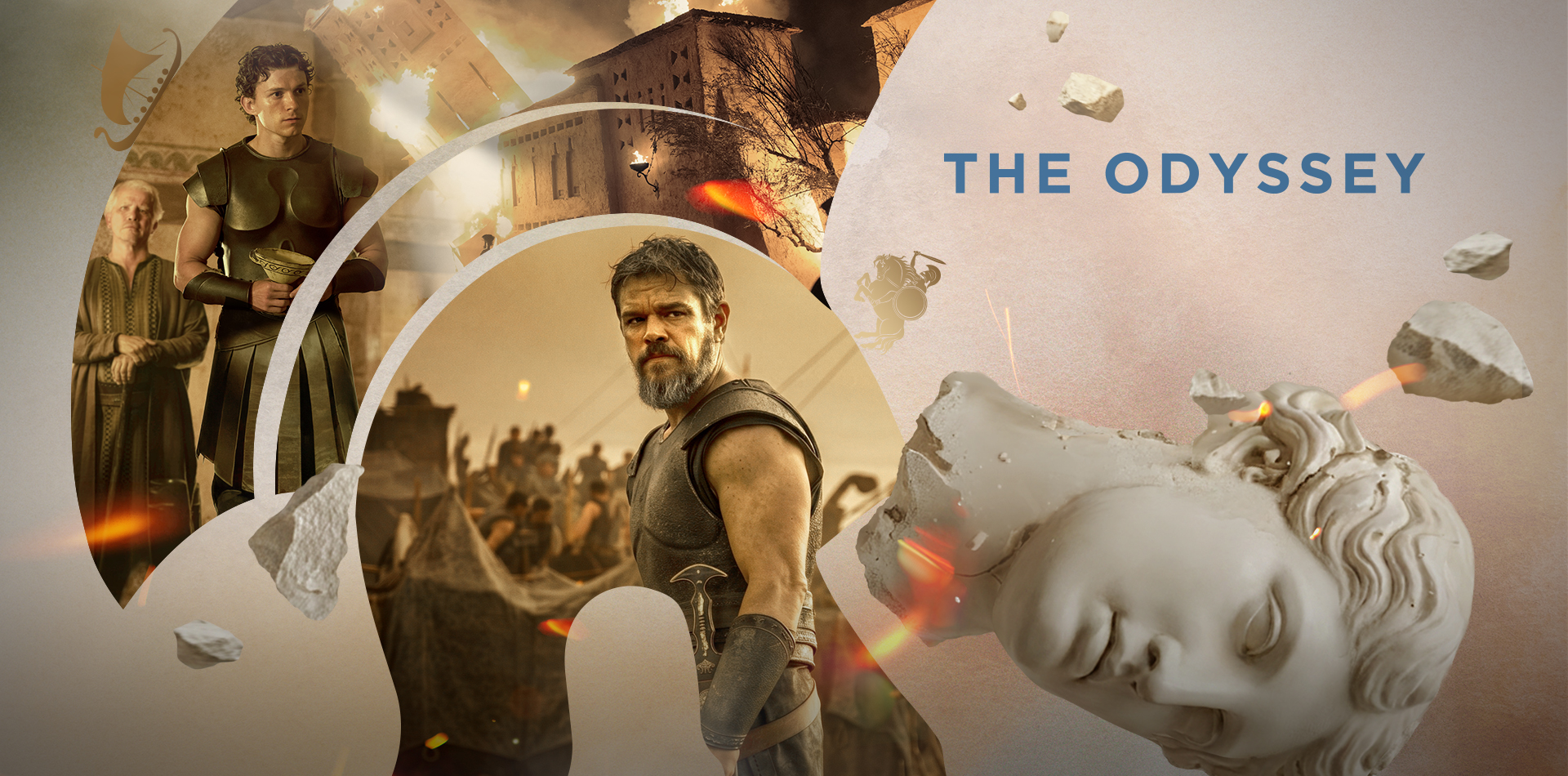
The very name Odysseus (Matt Damon) is synonymous with the heroic journey, and designing him was a storytelling master class. “Odysseus is not a clean hero, and he’s never static. He survives the collapse of a civilization, and that influences everything visually. The world after Troy is exhausted, haunted, and spiritually fractured. Every costume and silhouette carried that feeling of a world trying to remember itself after catastrophe.” The character walks a line between fate and free will, and must live with the consequences of the choices he makes to stay alive and return home. Aging and weathering the costumes definitively showed the characters’ trials and tribulations. “We did a lot of physical research on how erosion, salt, and sea degraded fabrics and metals. What would that do to bronze? To linen? To leather? Most heroes arrive fully complete on screen, but Odysseus deteriorates. He reconstructs, disguises, adapts, and survives. Over the course of the journey, the sea and time rewrite him. His design allows the audience to feel that erosion without losing the core of who he is.”
Interwoven with the story of Odysseus is a wide range of characters whose own motives and ambitions complement and conflict, starting with his own family. Penelope (Anne Hathaway) represents faith and loyalty in the face of increasingly menacing threats. “My whole performance was informed by Ellen Mirojnick’s costumes,” says Hathaway. “I spent the entirety of my filming time thinking about them. Then I thought, ‘She wears bright colors because she’s not in mourning, because her husband is not dead. She gets herself done every morning because every day is the day he comes home.’”
Mirojnick explains, “Odysseus is constantly on the move. Penelope is still. She carries this immense psychological depth and endurance. She wears the colors of the house of Ithaca. I needed Penelope to capture a restraint. Her fabrications start soft and move into a harder edge. At the loom there is a softness in the textiles.” As the embattled character confronts what seems inevitable, she sets the task, and trap, for her suitors. “The costume that she wears starts with a very strong gold necklace. It bleeds into a dress that has the sharpest, most precise drapes. Just as Odysseus needed his silhouette, at the moment she sets the challenge, she is the warrior. I wanted her to feel that power emanate from her, but in a still way.”
Telemachus (Tom Holland) is torn between loyalty to his family and his own ambitions. “He exists between inheritance and absence. As the story goes on, his appearance comes from specific experiences. In the beginning his costumes are echoes of Odysseus. There’s no identity yet. When he goes to Mycenae, his identity becomes stronger. Menelaus actually gives him confidence to be able to become the king.”
Patron and confidante Athena (Zendaya) appears only to Odysseus. She is his conscience and guide who keeps him on the path. “Her costume language had to be strong and simple at the same time. You needed to see an intelligence, an unseen hand. She was Odysseus’s wisdom, and you needed to feel that. Athena moves through the human world without ever belonging to it. All of that needed to be of a beautiful neutral base as she moves through time and memory.”
If Athena is Odysseus’s conscience, Calypso (Charlize Theron) is his healer, warden, and lover. Exotic and dominant, she eventually coaxes his mind back from the horrors of war, but at the cost of his memory and many long years of subjugation. “Calypso lives in the most isolated place in the world, but she is self-sufficient. She is always in the water. She had to fish to live and survive. We created a fishing net, an apron that she would just strap on with a very large basket attached, so she can capture fish and bring them back. It was a utilitarian, purposeful piece of costume that was part of her identity.”
Draped in privilege and entitlement, Penelope’s suitors are guilty of the most depraved of crimes in ancient times: They are discourteous to their host and take advantage of her hospitality. Their decadence is more than a symptom; it is the underlying disease of a society breaking down. Antinous (Robert Pattinson) is the most polished of the suitors, but also the most snide and treacherous. “For these men who, with ambitions of becoming kings, indulgence is never too much. They are overly layered and decorated. They wear everything they have on their backs.”
Helen (Lupita Nyong’o) is a queen trapped in a cage of circumstance and her own machinations. “There was an image I came across of a broken statue, and it really resonated very deeply. We created a sculptural neck and chest plate. It sat over her shoulders and looked like a broken statue. After that, the gown that I created was something that looked like fire wrapped around her. The last costume that you see her in is a piece of golden woven metal that is about 30 pounds in real life,” she laughs, “but Lupita loved it. It was like the heaviness of her position.”
Making a film as ambitious as this requires a steady hand at the helm, and Mirojnick is quick to point out the leadership director Christopher Nolan provides. “Chris is one of the most inspiring people I have ever met in my entire career. He approaches filmmaking, and the material, through physical truth. He is completely energizing because everything matters—from the initial design through the materials, the aging, and the physical construction. The costumes are never just isolated objects. They become part of the architecture of the film itself.”