


By Allana Johnson | November 10, 2026
Blade Runner 2099 with costume designer Helen Huang
The neo-noir aesthetics of the Blade Runner universe have become a staple of sci-fi since the foundational Ridley Scott film in 1982. In a new Prime Video series, the formerly enslaved Replicants are now the masters after winning a bloody war, and humanity is reduced to servitude. Blade Runners, who once hunted rogue Replicants, now hunt human insurgents and enforce the new social order with the same ruthlessness with which they were once oppressed.Costume designer Helen Huang’s challenge was to maintain continuity with previous iterations of the Blade Runner universe while showing the cultural progression and new lore. Showrunner Silka Luisa dubbed the approach “sunshine noir,” which introduced more light and color into the world, while maintaining its roots in noir. Huang explains, “Obviously the first film is the main inspiration. You also have to take into account the Denis Villeneuve version, which is an amazing sequel, even though it’s a standalone movie.”
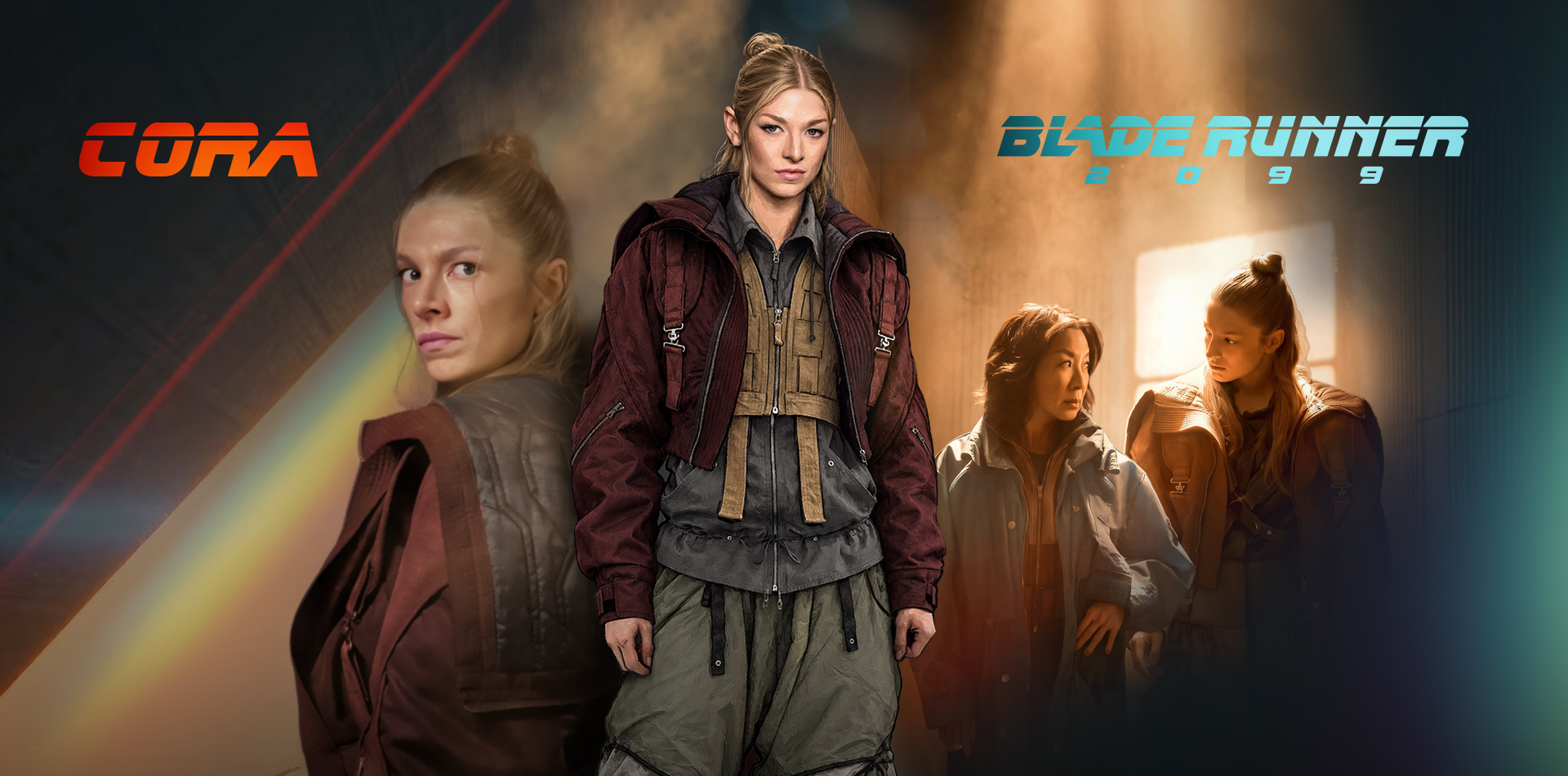
Desperate to escape the city and oppression of the Replicants, Cora (Hunter Schafer) must pretend to be a Blade Runner in order to get safe passage for herself and her ailing brother. Her disguise references the ‘80s look of the first film, and incorporates punk elements. “We looked at a lot of designers like Stone Island, CP Company, Giorgio Armani, and men’s sportswear that had military influences. When the function of the garment becomes central, it affects the look. We took that legacy and tailored it to our version. Cora is very vulnerable and has to think on her feet. We wanted her outerwear to present a defense mechanism against what her character is going through, so we did the big shoulders, and made it very round. The hood unzips and it creates this very big sort of lapel on her. She feels very different when she’s standing next to Olwen.”
Coming to the end of her lifespan, Blade Runner Olwen (Michelle Yeoh) is a world-weary detective, but she holds onto memories and friendships as an emotional and sometimes literal lifeline. “We took the iconic detective noir feeling and kept it with Olwen,” Huang notes. The question was how to deconstruct the traditional film detective trench coat through the Blade Runner world while also taking it into a new generation. The military history of the trench coat suited the modular utility of the show. “Her coat was a collaboration that we did with Stone Island. They did a collection the year before that was based off of Blade Runner, so it was kismet.” The show explores what it means to be human, and one of the ways Huang showed the contrast was in her choice of textiles. Materials that feel more organic would represent humanity, while Replicants wear items that are more synthetic. “For Olwen, we wanted both at the same time, to play with the idea of her being a Replicant. How human is she? Because the coat has two layers, the undercoat is sort of a more organic-looking, cotton-feeling trench coat, and on top, we added a more synthetic-feeling, smaller coat that zips on.”
To construct a boot that becomes a plot point in the first episode, Huang reached out to Reebok. “They did the original Alien boot and a lot of collaborations in the ‘80s, so I thought it’d be a great Easter egg for our show. I sent them ski boots and boots from the 1960s and things that had an inside component and an outside component. We developed a dust shield so you could change the silhouette, depending on who’s wearing it. It doesn’t look sleek and futuristic, but has its own heft, so everything looked really analog. There were three different layers of the boot that worked as the season progressed.”
After the first episode, Cora is pretending to be a Blade Runner, so Bebeto (Dimitri Abold) and his family step in to represent humanity. The human characters represent an oppressed second class, but Huang wanted to show their strength in the face of adversity. “We thought of the human population as very resilient, people who have a lot of creativity, a lot of inspiration. They want to survive, and this is how it looks as they do it. Bebeto is a collector, because he operates a kind of pawn shop, but he’s also a doctor. We tried to collage a lot of his and his family’s clothes together, to make it feel very piecemeal but also very intentional. They collected resources, and made a lot of their own clothing. The fabric we used on his jacket, we would put on his mother’s dress. They also found a lot of vintage clothing that gets passed down or gets taken apart and made into something else. So we built a lot of their clothes.”
Cora’s ailing brother, Elias (Lewis Gribben), is grimly independent despite having physical limitations. Fierce but frail, the character stands out in both his color palette and silhouette. “We really wanted to dress Elias as if he’s marching to the beat of his own drum. There was a lot of color and we wanted to keep his garments simple because he wouldn’t be going out and he’s not dressing up for anybody. But we wanted the colors to represent how vibrant he is internally, even though he has a physical ailment. We amped up an ordinary pair of sweats for him to where he really fits into this world where it shows his vibrancy inside despite what’s happening on the outside. Elias has a lot of opinions, and we wanted to really show that he has his own philosophy.”
The end result of these efforts is a project that maintains fidelity to the source material while moving it forward into a contemporary context that remains open to the future. “With an IP as important as Blade Runner,” Huang explains, “it could have a very narrow scope where they don’t want to depart from the original, but Luisa said, ‘Let’s take the concepts of the original, add in what we like, and then develop something that feels unique and new.’ To me, that is the best way to collaborate.”