


By Allana Johnson | November 10, 2026
Ray Gunn: A Conversation with costume designer Neysa Bové
and Director Brad Bird:
Animation VS. LIVE ACTION
BRAD BIRD: People ask, “What’s the difference between animation and live action?” It’s just the methodology you use to put things on the screen. It’s still shots, it’s still acting, it’s still color, it’s still design, it’s still music. Every element that’s in live action is also in animation. I am constantly battling for it to be seen as film because I’ve done live action and animation and I love both. They’re much more similar than they are different.
NEYSA BOVÉ: I would say the same thing with costume design in animation. You treat a character the same way you would in live action. You read the script, you talk to the director, you ask questions. What do you want to feel when you look at this character? You do your period research and you design. The difference is in the execution. That’s it. We execute in a digital world. You know, we might grab fabrics from real life to inform the team. We don’t get anything for free. Down to a button, zipper, pocket, every single stitch has to be designed and built.
FIRST MEETING
BRAD BIRD: When we first met, you were hit with the size of the project. It’s big.
NEYSA BOVÉ: I was so excited because you kept saying more dresses! That’s music to my ears. It was a massive film, but such an opportunity to elevate costume design in animation. It’s probably the most costume-heavy film I’ve worked on and it looks beautiful. We made it happen. I really appreciate how open-minded you were about creating what the story needed. In animation we get a lot of pushback about building too much for production reasons, but the story is the boss, and we’re delivering what it’s asking for.
RESEARCH
BRAD BIRD: One of the interesting challenges of the film is that it’s retro, but also futuristic. We typically associate detective film noir with the late ‘30s and ‘40s or early ‘50s. That’s where it lives in our imagination. It’s the future as seen from 1939. We mix and match a little bit when it feels right, but that was the general take.
NEYSA BOVÉ: It was about striking the right balance between historical and futuristic. I researched the technology that existed in the 1930s, particularly these beautiful Streamline Moderne Bakelite radios. We used them as a basis for the costuming, incorporating Bakelite into accessories like buttons, tie knots, earrings, and glasses. We also took inspiration from the radio grille fabric, using it for men’s ties and as paneling in women’s 1940s jackets. Ultimately, combining 1940s silhouettes with these unexpected materials gave us that sense of retro futurism.
COLOR PALETTE
BRAD BIRD: I think that color is always connected to story. You want a flow of colors in the same way that there’s a flow of emotions. Color is a great way to bypass the intellectual and get to the emotions.
NEYSA BOVÉ: Technicolor was a huge inspiration for costuming colors. We would look at films like Cover Girl and see what color conveyed. We talked about separating Venus’s multiple personas. There’s Megamax Venus with a very specific palette given to her by her brand. Then there’s Venus off duty. She wears a palette that ties to who she really is. It’s a beautiful periwinkle color that you will see throughout the movie. Ray stays pretty consistent throughout the film colorwise, because he doesn’t have that extra arc that needs that change of color. Venus has quite a complex color evolution. At the end we land on white to demonstrate a final reborn moment in her development.
ALIENS
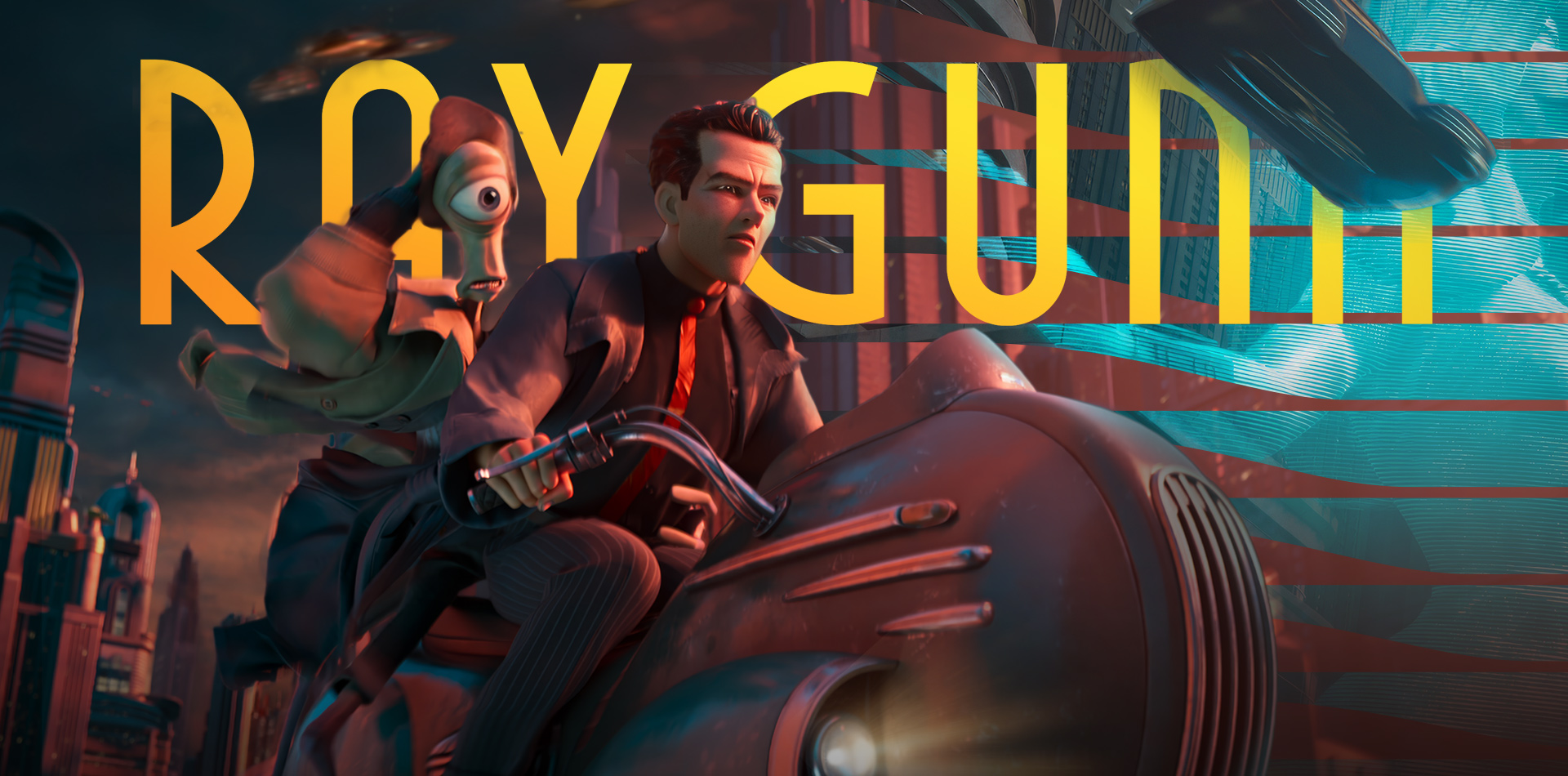
BRAD BIRD: Eye-Ra, Ray’s cohort, has tripod legs and he moves like a spider. Constructing a costume that makes him identifiable not only as a private detective, but as an alien with three legs, had to be really challenging.
NEYSA BOVÉ: I was able to work with Doug Frankel, Tony Fucile, and Michal Makarewicz. They’d say, “What pocket can we use?” In animation, if you want to use a pocket and have it interactive with the character, you must add that extra simulation rig. So we’d have these meetings, and they would describe what performance they wanted. And then we adapted costumes so they could fit what they’re looking for.
Eye-Ra’s costume was challenging. He needed that oversize coat because that’s his character. He’s got this slouchy, Columboesque trench coat. Typically, in CG animation, going tight is easier and cheaper. We stayed away from that. It’s a clear performance even though he’s wearing a bigger, baggier coat. That was really fun to figure out. I looked at actual Columbo jacket videos to
imitate behavior for that specific gabardine material, and shared with Cinesite.
BRAD BIRD: When you’re directing a specific character’s costume, if you spend more here, you might have less to spend there. You have to weigh how important is it that he have this slouchy thing. Sometimes it’s really important.
NEYSA BOVÉ: We don’t do enough of that in animation. We had three chances for Ray to put his coat on and take it off. That’s very expensive—character interacting with fabric. It’s a lot of hand holding to just have a character remove and drape a coat over a chair. The animation doesn’t automatically do this. We art direct every frame to make sure it feels natural and effortless.
BRAD BIRD: Anytime you’re dealing with sci-fi, you are sometimes dealing with elements like gravity that affect how the simulation reacts. You get a lot for free in live action. In animation, you have to anticipate and build it digitally.
NEYSA BOVÉ: Things which exist in the natural world all have to be recreated. If you want silk, the team has to draw it from scratch and paint a texture that looks like silk. You can’t just buy a bolt of fabric and have it fall perfectly.
BRAD BIRD: Sometimes the first pass you get looks shiny in the right way, but it doesn’t react in the right way. So you say, OK, we got the shininess, but the fabric feels light. It should feel a little heavier.
DETAILS
NEYSA BOVÉ: One thing I love about the accessories in the film is that it feels very Hitchcockian. The camera closes in on the props because they are part of the storytelling. I haven’t worked on a film that is so meticulous with props. These accessories had to be done right because you would see them in great detail, and the characters are interacting with them.
BRAD BIRD: Detectives are trying to find stuff out. That means a lot of times they’re just looking through things without really knowing what they’re looking for. They’re just opening drawers and checking out things. We had a scene where Ray goes through a purse. In a live action, you just gather things that would be in the purse. In an animated film, you have to build everything.
Movies are a dream. They’re more like a dream language. There’s a poetry to dreams and to movies if they’re executed well, and you’re always in the search of that.